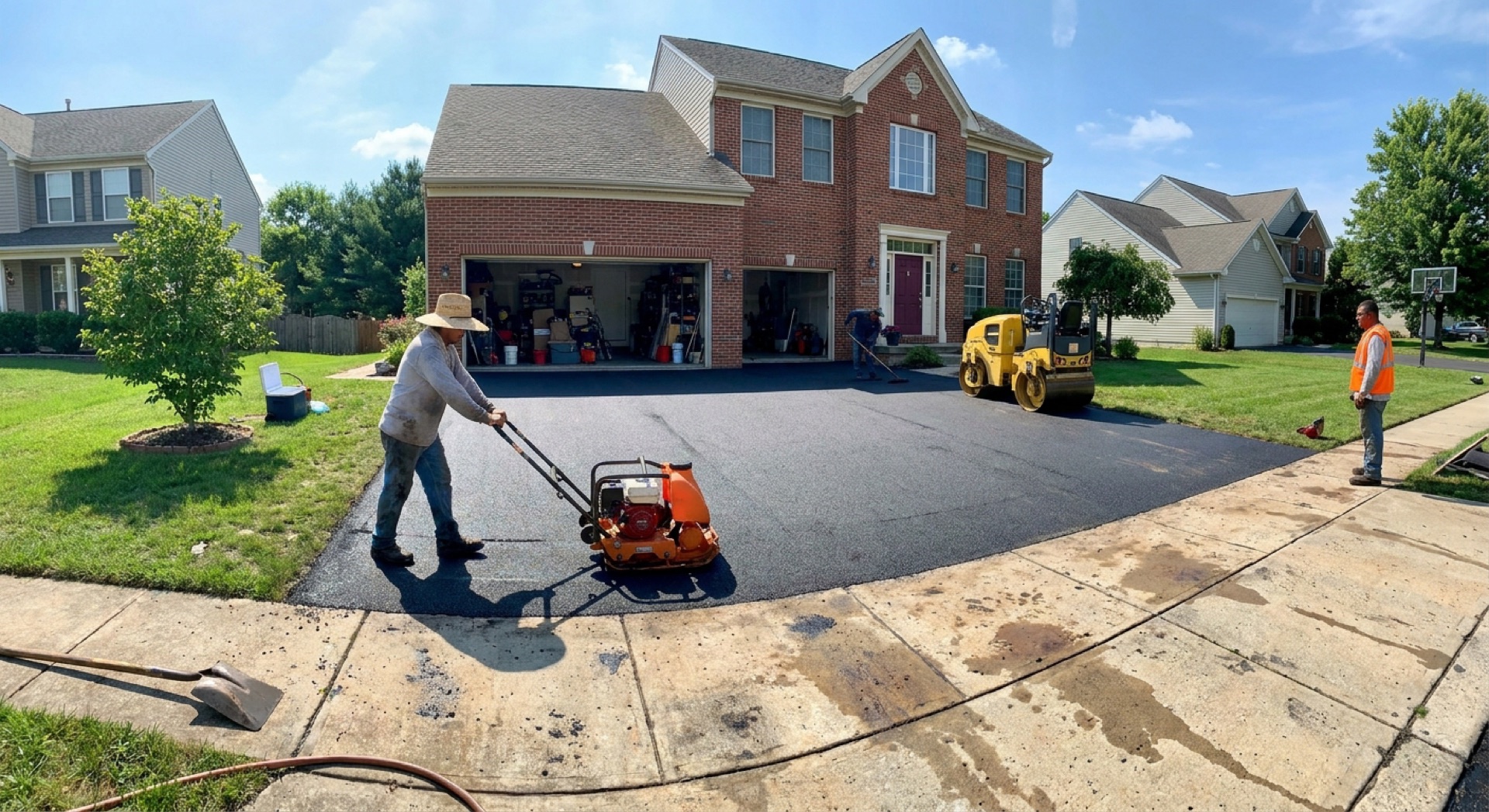
McLean Asphalt repairs damaged asphalt driveways throughout Fairfax County, Loudoun County, and Northern Virginia — from isolated crack filling to section-by-section patching to full resurfacing.
Most driveway damage in Northern Virginia is progressive: it starts with surface cracks, which allow water infiltration, which worsens during freeze-thaw cycles, which causes potholes and base failure. The earlier damage is addressed, the less expensive the fix. McLean Asphalt diagnoses the underlying cause of driveway damage and recommends the most cost-effective repair — whether that's crack sealing, patching, resurfacing, or replacement.
Crack sealing: $75–$250. Patching: $5–$15/sq ft. Resurfacing: $2–$5/sq ft. Full replacement: $4–$10/sq ft. Free estimate.
McLean Asphalt diagnoses and repairs every type of driveway damage in McLean, VA — cracks, potholes, edge failure, and base problems — with honest recommendations on patch vs. replace.
Linear cracks up to 1 inch wide are sealed with rubberized hot-pour crack filler, which flexes with temperature changes and prevents water from entering below the surface. Cost: $75–$250 for a typical driveway.
Interconnected surface cracking resembling alligator skin indicates base failure. The affected section must be removed, the base repaired, and fresh hot-mix installed. Cannot be fixed with sealer or crack fill alone.
Potholes and sunken areas are patched with hot-mix asphalt after removing all failed material and repairing the base. See our pothole repair page for detail on our process.
Driveway edges often fail first because they lack lateral support. We repair edge damage with hot-mix asphalt patching and recommend edge restraints or proper grading adjacent to the driveway edge.
Every repair starts with an honest assessment. We diagnose the underlying cause before recommending a fix.
We probe soft spots to determine if base failure is present, examine crack patterns to identify settlement vs. oxidation vs. root intrusion, and check drainage for pooling. The diagnosis determines the repair method.
For isolated damage, we scope a targeted repair. For widespread damage affecting 30%+ of the surface, we'll recommend resurfacing or full replacement — patching a failing driveway piece by piece costs more in the long run.
Cracks get rubberized hot-pour sealer. Potholes get saw-cut and hot-mix patch. Alligator areas get full removal and base repair. We use hot-mix for all structural repairs — never cold-patch for anything meant to last.
After the repair we walk the driveway with you and explain what caused the damage — drainage grade, tree roots, freeze-thaw movement. We recommend a maintenance schedule to prevent the same damage from recurring.
Repair cost in McLean varies widely depending on damage type, extent, and whether base reconstruction beneath the surface is required. The table below reflects permanent hot-mix repair rates — not temporary cold-patch, which costs less upfront but fails within 1–2 seasons and requires repeat expense.
Repair cost varies widely depending on the damage type and how far it has progressed.
| Damage Type | Typical Cost | Notes |
|---|---|---|
| Hairline cracks (<1/4") | $75–$150 | Rubberized crack sealer. Often included in a sealcoating job. |
| Wide cracks (1/4"–1") | $150–$250 | Hot-pour rubberized crack sealer by professional equipment. |
| Single pothole | $150–$400 | Saw-cut and hot-mix patch. Base repair adds cost if base failed. |
| Alligator cracking | $5–$15/sq ft | Must address base failure. Cannot be sealed over. |
| Edge crumbling | $10–$25/LF | Taper patch with hot-mix plus edge support. |
| Full resurfacing | $2–$5/sq ft | 1.5–2" hot-mix overlay on intact base. Extends life 10–15 years. |
| Full replacement | $4–$10/sq ft | Tearout, base rebuild, new surface. Required when base failed. |
The cost difference between a $200 pothole patch and a $1,200 base-reconstruction repair comes down to one factor: what's happening under the surface. A pothole where the base beneath is solid requires only surface patching — cut, clean, tack coat, hot-mix, roll. A pothole where the base has eroded (visible as a cavity beneath the asphalt when excavated) requires rebuilding the aggregate base before any asphalt is placed. That additional material and compaction work is what drives cost on the higher end.
This is why recurring potholes are a diagnostic signal, not just an inconvenience. When the same pothole keeps returning despite repairs, it means the base beneath has failed and the patch is sitting on unstable material. Each repair compresses the base further and enlarges the failure zone. At that point, the economical solution is one properly scoped full-depth repair rather than a third or fourth round of cheaper patching that fails again by next spring.
For larger driveway damage — widespread cracking, multiple depressions, significant edge failure — the comparison shifts from patching versus resurfacing to resurfacing versus full replacement. McLean Asphalt performs a written scope assessment before recommending either option, and we show you what we find during the base probe so the recommendation is transparent. We don't steer clients toward more expensive work when less expensive work is the right answer. Call 571-234-7040 for a free driveway assessment.
Not sure if you need service now or can wait? Here are the signs that indicate it's time to call McLean Asphalt at 571-234-7040.
A pothole that returns within one season of repair indicates active base failure at that location — often caused by drainage issues or an inadequate original base. When potholes recur in the same spot, cold-patch or surface-only repair is not solving the underlying problem. McLean Asphalt diagnoses the base condition under every recurring pothole and performs full-depth hot-mix repair when base reconstruction is needed.
Low spots that hold water after rain are not just a cosmetic concern — they're actively saturating the base beneath that area with every rain event. Saturation weakens the aggregate base and causes accelerated structural failure. Depressions need to be cut out, the base rebuilt, and new asphalt placed to restore proper drainage.
When driveway edges crumble and the asphalt is spreading outward laterally at the perimeter, the edge structure has lost its support. This typically happens when the aggregate base doesn't extend to the full edge of the paved area. Edge repairs require full-depth reconstruction at the edge zone — not just surface patching.
Walk your driveway and press firmly with your heel. If the surface flexes or feels springy, the base beneath is soft and no longer providing adequate support. A flexible asphalt surface is on the verge of developing potholes and depressions. Full-depth base repair is required at any location that shows flexibility under load.
Base reconstruction is identified during excavation — it cannot be reliably diagnosed from the surface alone. McLean Asphalt provides written estimates before work begins. Final cost may adjust if base conditions found during excavation differ from the surface assessment. Call 571-234-7040 for a free visit.