Asphalt Patching in McLean, VA

McLean Asphalt provides asphalt patching services for driveways and parking lots throughout Fairfax County, Loudoun County, and Northern Virginia.

Asphalt patching addresses localized failure areas — damaged sections that don't warrant full replacement. Whether it's a sunken area from a tree root, a section of alligator cracking from water intrusion, or a failed prior repair that needs to be redone properly, McLean Asphalt uses hot-mix asphalt to produce permanent, durable patches. We square-cut damaged sections to clean edges, correct the base if needed, and fill with matching-thickness hot-mix that blends smoothly with the surrounding surface.

Asphalt patching: $5–$15 per sq ft for smaller patch areas (higher unit cost than full paving due to mobilization). Free on-site assessment.

(571) 389-7109

Free Patching Estimate

Why McLean Asphalt is the Best at Asphalt Patching

McLean Asphalt performs structural asphalt patching for driveways and parking lots throughout McLean, VA and Fairfax County — we fix the base, not just the surface.

  • Mark and square-cut the damaged area with a saw or cold planer
  • Remove all failed asphalt and any compromised base material
  • Add compacted base material to match the surrounding depth
  • Apply tack coat on clean edges to bond patch to existing pavement
  • Fill with hot-mix asphalt in compacted lifts
  • Roll and compact to finish flush with surrounding surface
  • Honest assessment — we'll tell you when replacement is the better call
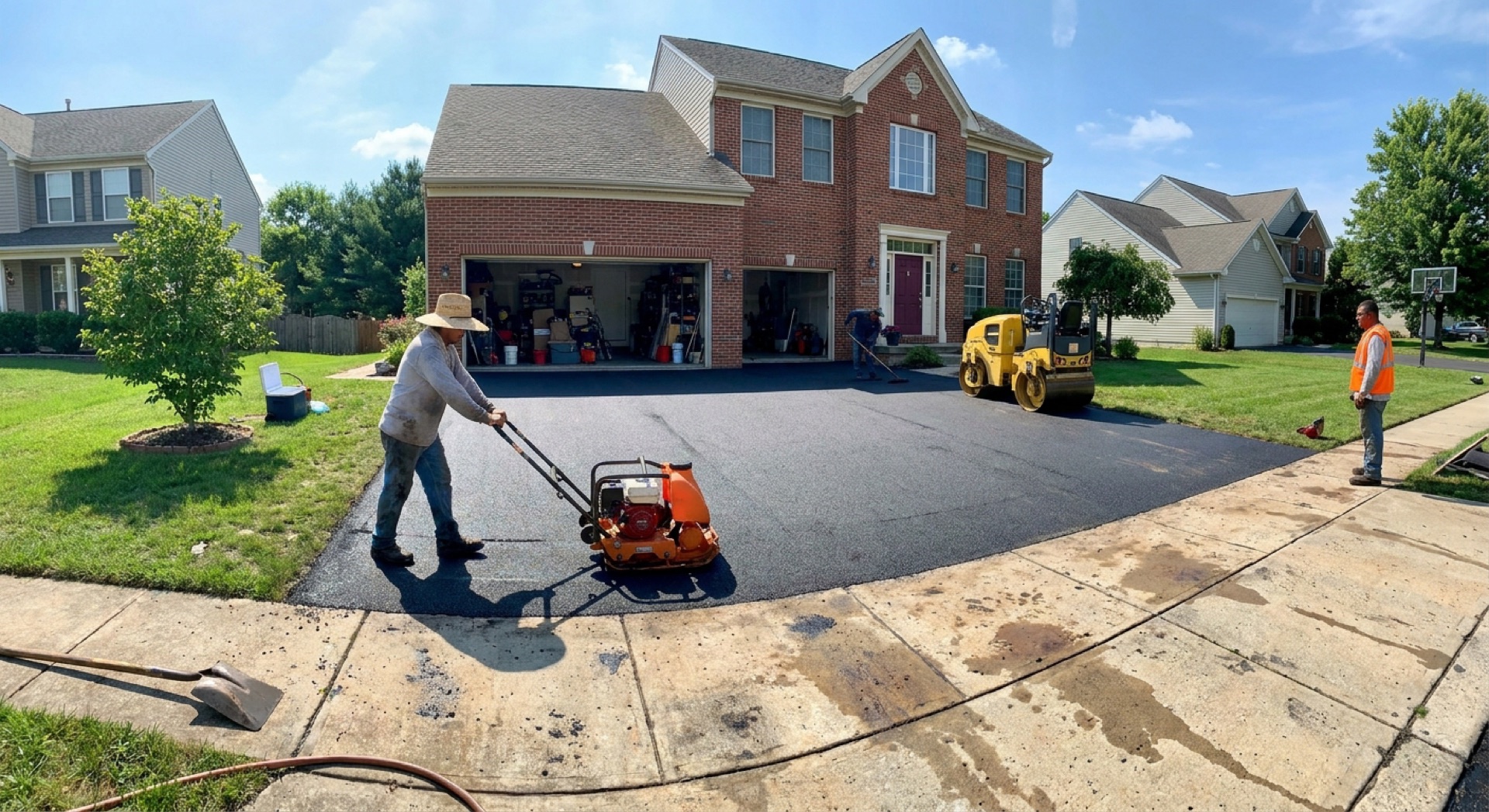
Asphalt patching Northern Virginia

When Patching Makes Sense vs. Full Replacement

Patch When:

The driveway or parking lot is in generally good condition but has one or more localized failure areas. The base is intact and the surrounding asphalt is sound. Total failed area is less than 25–30% of the total surface. Isolated root damage or utility cut repair.

Replace When:

Widespread cracking across more than 30% of the surface — a sign of base failure throughout. Extensive alligator cracking (interconnected surface cracks) indicating the entire base is compromised. When the number of patches needed approaches the cost of full resurfacing. We assess honestly and recommend the most cost-effective option.

Patching Methods — Infrared, Saw-Cut, and Cold Mix

The right repair method depends on damage type, depth, and how permanent the fix needs to be.

Infrared Patching

An infrared heater softens the existing asphalt, which is scarified, regraded with additional hot-mix, and recompacted. The repair bonds seamlessly — no visible seam line. Lasts 10–15+ years.

Best for: surface repairs, alligator cracking with intact base

Saw-Cut and Remove

Saw-cut a clean square around the damaged area, remove failed material to solid base, repair base if needed, install new hot-mix. Clean edges bond well and the repair looks sharp.

Best for: potholes, base failures, deep damage

Cold-Mix Emergency Patch

Bag or bulk cold-mix placed and compacted in a pothole. Workable in any temperature — right for emergency winter repairs when hot-mix plants are closed. Lifespan: 1–3 years pending permanent repair.

Best for: emergency/temporary winter repairs

Patch vs. Resurface vs. Replace — How We Decide

We give you the honest answer — even when it means recommending the cheaper option.

Patch It

Isolated damage — a single pothole, a crumbling edge section, a crack cluster — on a surface where surrounding pavement is still structurally sound. Patching 5–20% of the surface area is cost-effective and extends overall life.

Resurface It

Surface worn throughout but the base is intact. Significant cracking and roughness but no soft spots or alligator cracking. Resurfacing at $2–$5/sq ft is the cost-effective call versus $4–$10/sq ft for full replacement.

Replace It

Alligator cracking throughout, soft spots, or widespread base failure — more than 30–40% of the surface needs structural repair. Overlaying a failed base is money wasted: the new surface will mirror the old problems within 2–3 years.

Asphalt Patching Cost in McLean, VA

Patching cost depends on the repair method (infrared, saw-cut, or cold-mix), the patch size, and whether base reconstruction under the patch is required. The table below reflects hot-mix permanent patching rates — the type of repair that actually lasts. Cold-patch and infrared rates are included for comparison.

Repair TypeTypical CostExpected Lifespan
Cold-patch (DIY or temp)$20–$60 per bag1–2 seasons (temporary only)
Infrared repair — small area$250–$450 per repair5–10 years on stable base
Saw-cut hot-mix — small (1–3 sq ft)$150–$350 per patch10–15 years
Saw-cut hot-mix — medium (4–8 sq ft)$300–$600 per patch10–15 years
Saw-cut hot-mix — large (8–20 sq ft)$500–$1,200 per patch10–15 years
Full-depth base + patch (per sq ft)$12–$22/sq ftLifespan of surrounding pavement
Utility cut restoration (per sq ft)$15–$25/sq ftMatches surrounding pavement life

Multiple patches at the same property are priced together — volume savings apply. McLean Asphalt provides written estimates covering all repairs before work begins. Call 571-234-7040.

Patching vs. Resurfacing — How to Know Which Is the Better Investment

The decision between patching and resurfacing comes down to what percentage of the driveway or parking lot has failed. When isolated failures account for less than 20–25% of the total surface area, targeted patching is the more cost-effective approach — you repair the failed areas without replacing the sound material that doesn't need it. When failures are distributed across 30–40% or more of the surface, resurfacing the entire area becomes more economical than patching individual spots.

There's also a quality argument for resurfacing over widespread patching: a resurfaced surface is consistent, well-bonded, and drains uniformly. A heavily patched surface has multiple transition edges, varying surface heights, and inconsistent drainage patterns. For commercial properties where customer and tenant impression matters, a patched lot looks like what it is — deferred maintenance. A resurfaced lot looks like a new asset.

For residential driveways, the patching vs. resurfacing calculation often comes down to age and base condition. A 15-year-old driveway with isolated failures and a sound base is an excellent patching candidate — followed by sealcoating to protect the full surface. A 25-year-old driveway with widespread failures and a soft base is a full replacement candidate, regardless of what patching might look like on the surface. McLean Asphalt assesses age, failure extent, and base condition before recommending any scope. Call 571-234-7040 for a free assessment.

Signs You Need Professional Asphalt Patching

Not sure if you need service now or can wait? Here are the signs that indicate it's time to call McLean Asphalt at 571-234-7040.

Potholes Greater Than 6 Inches in Diameter

Small potholes (under 6 inches) can sometimes be maintained with consumer-grade cold patch as a temporary measure. Potholes over 6 inches — especially those that are deepening — need professional hot-mix patching with saw-cut edges and proper base repair beneath. Cold-patch material in a larger pothole will fail within one freeze-thaw cycle.

Isolated Alligator Cracking in Otherwise Sound Pavement

When a specific area of pavement has developed alligator (interconnected) cracking while the surrounding pavement is in good condition, that localized area has experienced base failure. Full-depth patching — removing the failed asphalt, rebuilding the base, and placing new hot-mix — addresses the specific failure zone without requiring resurfacing of the entire surface.

Settlement Depressions Over 1 Inch Deep

Depressions more than 1 inch deep that are collecting water need to be addressed with infraleveling or full-depth patching. Infraleveling uses a specialized asphalt-based fill to raise the depression to match surrounding grade; full-depth patching rebuilds the base if settlement is caused by base erosion. McLean Asphalt assesses which approach is correct for each depression.

Utility Cut Patches That Have Failed

Utility cuts — where gas, water, electric, or cable crews have cut through pavement for underground work — are a common source of premature pavement failure. Utility companies often use minimal-spec cold-patch for temporary restoration. When those temporary patches fail, McLean Asphalt provides permanent hot-mix replacement with saw-cut edges.

Asphalt Patching FAQ

How long do asphalt patches last?
A properly installed hot-mix asphalt patch lasts 10–15+ years — approximately as long as the surrounding pavement. The key is proper preparation: square-cut edges, tack coat application, correct base depth, and adequate compaction. Patches that fail prematurely are almost always due to skipped steps, particularly tack coat omission or insufficient base repair.
Can you patch over an existing patch?
We can, but if a previous patch has failed, the correct approach is to remove it entirely, identify why it failed (usually a base issue), correct the underlying problem, and install a new patch properly. Patching over a failed patch without addressing the cause just repeats the failure.
Why does asphalt patching cost more per sq ft than full paving?
Small patches have higher per-square-foot costs because the mobilization cost (truck, equipment, crew, hot-mix minimum load) is spread over a smaller area. A $400 patch on a 40 sq ft area is $10/sq ft, while a $4,000 full driveway on 600 sq ft is under $7/sq ft. This is normal and expected — the comparison is not apples-to-apples.
How does McLean Asphalt approach permanent pothole repair?
Our permanent pothole repair process: (1) Saw-cut clean vertical edges around the pothole extending to stable surrounding pavement; (2) Excavate all loose material down to stable base; (3) Assess base — if the base has eroded under the pothole, rebuild with compacted 21-A aggregate; (4) Apply tack coat; (5) Fill with hot-mix asphalt in compacted lifts; (6) Roll smooth to match surrounding grade. This produces a repair that lasts 10–15 years — not one that re-fails the next season.
How much does professional asphalt patching cost?
Permanent hot-mix asphalt patches in the McLean area run $150–$400 per pothole or patch for standard 1–4 sq ft repairs. Larger repairs or repairs requiring base reconstruction run $400–$1,000+. Multiple patches on the same visit are priced together with volume savings. McLean Asphalt provides a free written estimate covering all visible repair areas before any work begins.
Can you patch just one section of my driveway?
Yes. Targeted patching is the right approach when isolated sections have failed while the surrounding driveway is still in good condition. We patch to the stable surrounding pavement edge and feather the new asphalt into the existing surface. A well-done patch is barely distinguishable from the surrounding pavement. When more than 30–40% of a surface needs patching, we typically recommend resurfacing the full area for a more consistent result.
Why do some asphalt patches fail quickly?
The three most common causes of premature patch failure: (1) Cold-patch material instead of hot-mix — cold-patch doesn't bond and fails in freeze-thaw; (2) No saw-cutting — irregular broken edges allow water infiltration along the patch perimeter; (3) Unrepaired base — patching the surface without rebuilding eroded base beneath means the patch punches through with the next heavy rain. McLean Asphalt addresses all three on every job.

Schedule Asphalt Patch Repair

Don't let a damaged section spread. McLean Asphalt assesses and patches driveways and parking lots throughout Northern Virginia.

(571) 389-7109 — Call for a Free Estimate
(571) 389-7109