McLean Asphalt installs, resurfaces, and maintains commercial parking lots for businesses, HOAs, and property managers throughout Fairfax County, Loudoun County, and Northern Virginia.
A deteriorated parking lot is a liability — it creates trip hazards, vehicle damage exposure, and a poor first impression. McLean Asphalt provides full parking lot paving services from new installation to full resurfacing, backed by a Class A Virginia contractor license and over 15 years of Northern Virginia experience. We work directly with property managers, HOA boards, and business owners to develop paving plans that fit budget and minimize disruption.
Parking lot paving: $1.50–$5+ per sq ft depending on scope. Full resurfacing vs. new installation affects pricing significantly. Free on-site estimate.
McLean Asphalt paves and resurfaces commercial parking lots throughout Northern Virginia — phased scheduling, ADA compliance, and annual maintenance programs available.
Full installation from grading and base preparation through paving and striping. We coordinate with site engineers on grading and drainage requirements and ensure the lot meets Fairfax County or Loudoun County commercial site requirements.
When a parking lot's base is still structurally sound but the surface is worn, cracked, or pitted, full resurfacing is the most cost-effective solution. We mill the existing surface or overlay it with fresh hot-mix asphalt at the appropriate thickness.
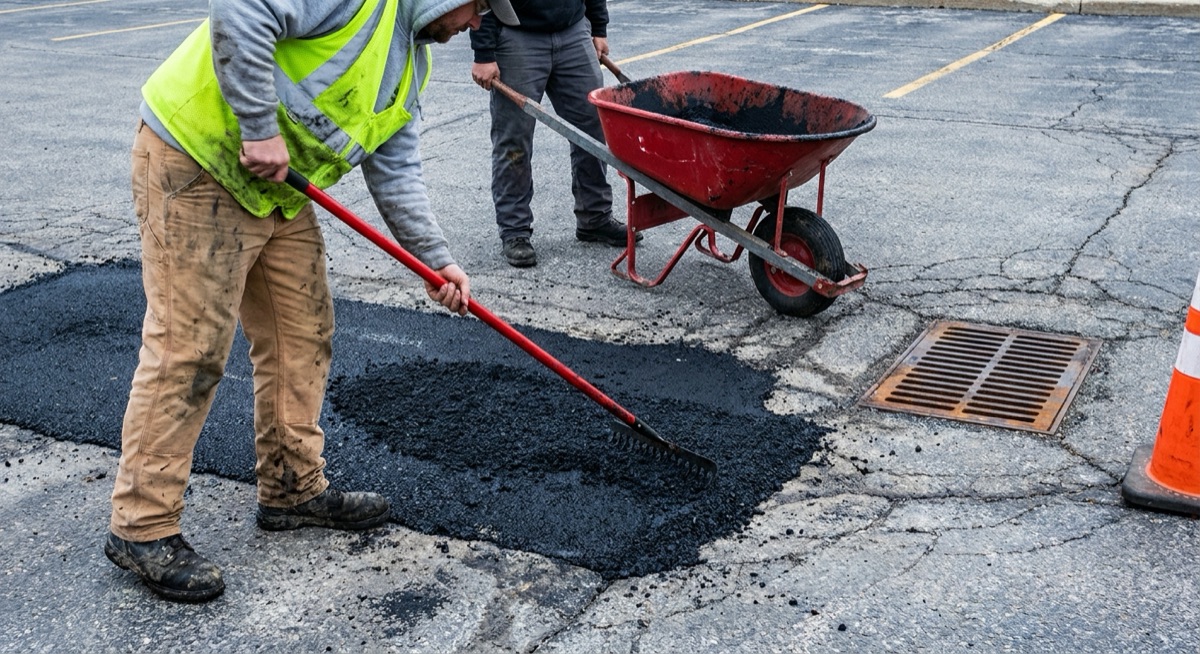
We repair individual potholes, failed patches, and localized damage areas using hot-mix asphalt. For lots with widespread pothole problems, we assess whether section-by-section patching or full resurfacing makes more financial sense long-term.
After major repairs or on a maintenance schedule, we sealcoat commercial lots and restripe parking stalls, fire lanes, ADA spaces, and directional markings using traffic-grade paint that holds up to Northern Virginia winters.
Every commercial project follows a structured process that minimizes downtime and delivers a surface rated for years of traffic.
We inspect drainage, grade, curb condition, and existing pavement zone by zone. We identify areas needing base repair before overlay. The assessment informs spec and quote — no surprises after work begins.
Localized base failures, sunken areas, and drainage low spots are repaired before surface work. Patching bad sections now prevents them from reflecting through a new overlay within a year.
If the existing surface is too high at curbs or building entrances, we mill before overlaying. This ensures the finished surface matches elevation at all transitions and drains toward the storm drainage system.
Hot-mix is machine-laid and rolled. After curing, we apply line striping, ADA markings, directional arrows, fire lane paint, and any parking management signage. The lot returns to service with all markings fresh and compliant.
The most important cost insight for commercial property owners: a well-maintained lot costs 30–50% less over its lifetime than a neglected one. The table below maps the full lifecycle of a commercial parking lot — what maintenance is needed at each phase and what it costs vs. what deferred maintenance eventually requires.
A well-maintained lot doesn't need full replacement until year 25–30. Proactive maintenance saves 30–50% vs. reactive replacement.
| Phase | Timing | Service | Typical Cost |
|---|---|---|---|
| Years 1–3 | After cure | First sealcoat + restripe | $0.25–$0.60/sq ft |
| Years 3–6 | Every 2–3 years | Sealcoat + crack fill | $0.25–$0.60/sq ft |
| Years 10–15 | Surface wear | Crack fill + patch + restripe | $0.50–$2/sq ft |
| Years 15–20 | Cracks spreading | Overlay (mill and pave) | $2–$5/sq ft |
| Years 25–30+ | Base failure | Full replacement | $3–$7/sq ft |
The most important line item in any parking lot resurfacing or reconstruction proposal is the base specification — what thickness of aggregate base is specified, and what asphalt thickness and mix type is proposed. A 3-inch asphalt section over a 6-inch base handles standard parking and light commercial traffic adequately. A lot that receives regular delivery trucks or heavy vehicles needs 4 inches of asphalt over 8 inches of base. A proposal that doesn't specify these dimensions leaves you unable to compare bids or know what you're actually getting.
Mill-and-overlay versus full reconstruction is the other major cost fork. Resurfacing (mill-and-overlay) is appropriate when the base is structurally sound — it removes the failed surface layer and replaces it without disturbing the base. Full reconstruction removes everything and rebuilds from subgrade — necessary when base failure is widespread. The cost difference is 2–3x. McLean Asphalt performs base probe testing on every commercial lot estimate and documents findings in writing before recommending either option.
For HOA boards reviewing parking lot proposals, McLean Asphalt provides proposals in a format designed for board review: itemized scope by phase, ADA compliance assessment, phasing calendar showing when each section of the lot is closed, and a 5-year maintenance projection showing expected preventive maintenance costs after the project. We also attend board presentations when requested and answer technical questions directly. Call 571-234-7040 to schedule a parking lot assessment.
Not sure if you need service now or can wait? Here are the signs that indicate it's time to call McLean Asphalt at 571-234-7040.
Widespread interconnected cracking indicates base failure that has progressed past the point where crack sealing alone is cost-effective. At this threshold, mill-and-overlay (milling off the failed surface and replacing it) becomes more cost-effective than resurfacing with multiple repairs beneath. McLean Asphalt assesses base condition before recommending resurfacing vs. full reconstruction.
Recurring potholes in the same location signal active base failure — drainage issues or inadequate original base construction are the typical causes. When potholes return within one season of repair, the base beneath needs to be rebuilt, not just the surface. McLean Asphalt diagnoses root cause before patching to avoid recurring repairs.
A parking lot that ponds water after rain has grade or drainage problems that are damaging the base on every rain event. Water infiltration through standing water saturates and weakens the aggregate base faster than any other single factor. Re-establishing proper drainage grades during a resurfacing project is far less expensive than repeated base repairs from ongoing water damage.
Current 2010 ADA Standards specify accessible space count, dimensions, access aisle widths, cross-slope maximums, and signage requirements. Lots built before 2010 may not meet current standards. A parking lot resurfacing project is the right time to upgrade accessible space layout to current compliance — combining the upgrades with resurfacing minimizes total cost and disruption.
McLean Asphalt provides written multi-year maintenance projections for commercial property owners and HOA boards — showing expected maintenance costs by year and how proactive spending compares to reactive replacement. Call 571-234-7040 to schedule a lot assessment and receive a maintenance projection.