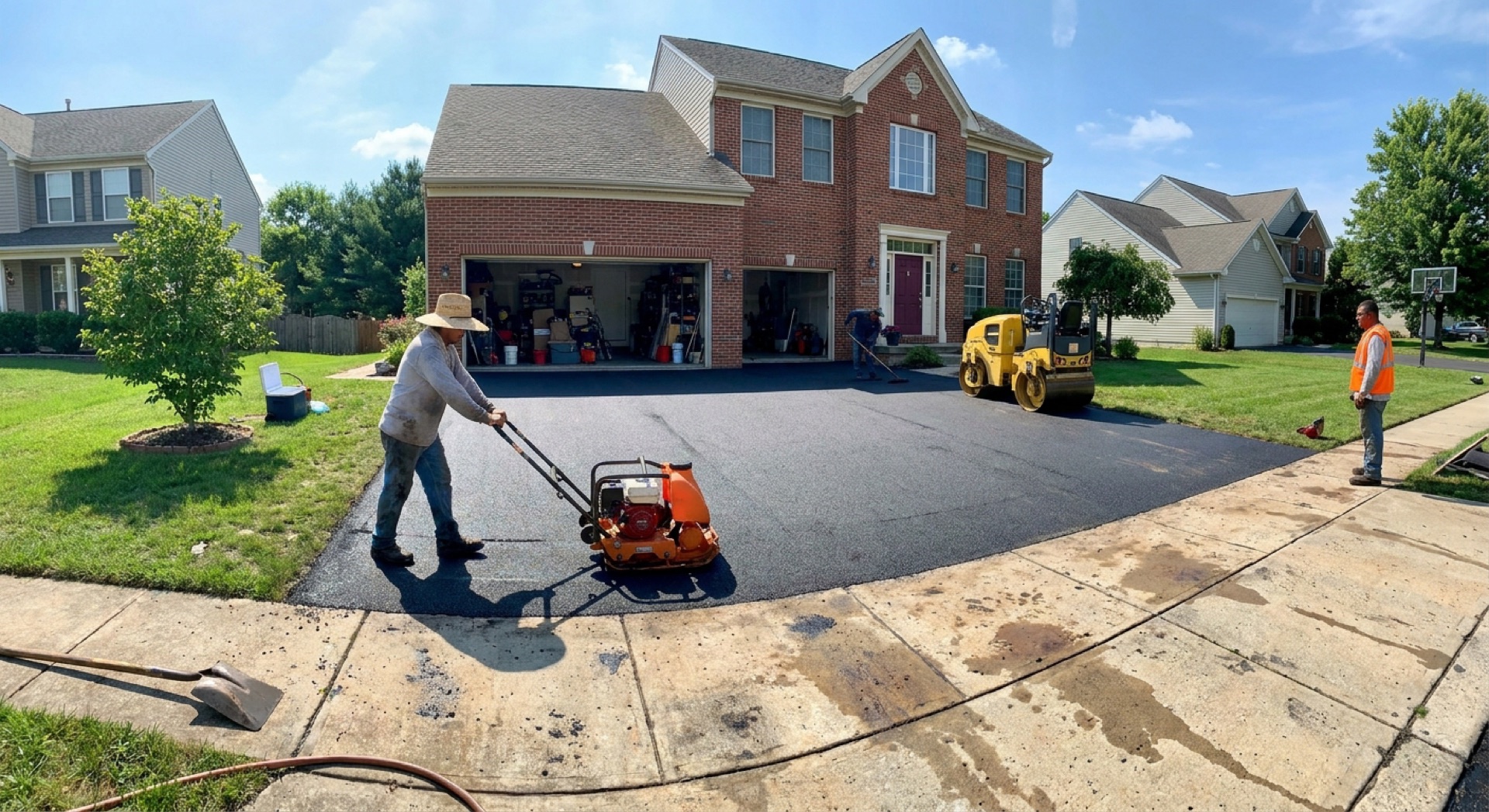
McLean Asphalt installs recycled asphalt millings driveways for homeowners throughout Northern Virginia — particularly on rural and semi-rural properties in Loudoun County, western Fairfax County, and Great Falls.
Asphalt millings (also called recycled asphalt or RAP — recycled asphalt pavement) are the granular material produced when existing asphalt pavement is milled up from roads and parking lots. When spread and compacted properly, millings bind together over time due to the residual asphalt binder in the material, creating a surface that's more stable than gravel and significantly less expensive than new hot-mix asphalt. For long rural driveways or properties where full asphalt isn't in the budget, millings are an excellent choice.
Asphalt millings installation: $1–$3 per sq ft including material and spreading. Significant savings vs. hot-mix for long driveways. Free estimate.
McLean Asphalt installs asphalt millings driveways throughout Northern Virginia — the most cost-effective paved driveway surface, starting at roughly one-third the cost of hot-mix.
Cost: $1–$3/sq ft installed. Appearance: Dark gray, similar to asphalt. Performance: Binds over time, more stable than gravel, dust-free. Best for: Long rural driveways, horse farm entries, cost-sensitive applications.
Cost: $4–$10/sq ft installed. Appearance: Smooth, dark black when new. Performance: Highest durability, cleanest appearance. Best for: Suburban driveways, properties where curb appeal matters, high-traffic areas.
Cost: $0.50–$2/sq ft installed. Appearance: Loose stone, tracks into garage. Performance: Requires periodic regrading, washout risk on grades. Best for: Temporary surfaces, very low traffic.
Millings work exceptionally well in the right context. Here's where they deliver the best value in Northern Virginia.
Estate driveways in Great Falls, Aldie, and rural Loudoun can run 300–600+ linear feet. Hot-mix for a 500 LF estate driveway can cost $30,000–$60,000+. Millings deliver a clean, dust-free surface at $5,000–$15,000 for the same length.
Farm lanes, barn access, and equipment paths benefit from millings' durability and drainage. Unlike gravel, millings don't rut as severely under tractor loads, and the binders create a more stable surface through wet seasons.
Construction sites often install millings as a temporary working surface during the build, then pave over with hot-mix when complete. The compacted millings act as the aggregate base layer — the cost applies toward the final driveway.
Churches, wineries, event venues, and farm markets use millings for overflow lots. Low cost per square foot, stable under light vehicle traffic, and easy to expand or reconfigure as needs change.
How much ongoing maintenance does a millings driveway require compared to regular asphalt?
Recycled asphalt millings are the most cost-effective driveway surfacing option available. The primary cost variables are total area, base preparation required, haul distance, and compaction passes. Compare these rates directly against hot-mix alternatives when evaluating your project.
Millings pricing varies with material availability and haul distance. McLean Asphalt provides written estimates after an on-site assessment. Call 571-234-7040.
The cost comparison between millings and hot-mix is straightforward on paper — millings cost 40–60% less per square foot installed. For a 2,000 square foot estate driveway, that's a $8,000–$14,000 difference. But the right choice depends on more than upfront cost. The questions to ask: Does your HOA or jurisdiction permit millings? Will the texture and appearance work for your property? Is a long-term hot-mix surface more consistent with your property value?
Millings perform best when placed over a sound, stable base. If the existing base under a gravel or dirt driveway is soft or poorly graded, base preparation adds $0.50–$1.50 per square foot to the project — which narrows the cost advantage but is still necessary for the millings to perform. Placing millings over an inadequate base produces ruts and soft spots within 1–2 seasons. McLean Asphalt assesses base condition before recommending millings and specifies base prep when it's required.
One advantage of millings that doesn't appear in the cost table: recycled asphalt millings harden over time as the residual binder cures, creating a progressively firmer surface with each year. A millings driveway installed today will be noticeably firmer in 3–5 years than it is on day one. Occasional regrading and fresh top-dressing every 5–8 years at $0.50–$1.00 per square foot keeps the surface renewed without the full cost of new installation. Over a 20-year horizon, a maintained millings driveway is significantly less expensive than a hot-mix driveway with full replacement. Call 571-234-7040 for a written millings estimate.
Not sure if you need service now or can wait? Here are the signs that indicate it's time to call McLean Asphalt at 571-234-7040.
For driveways over 300 feet — common in Great Falls, Oakton, and rural Loudoun County — the cost of full hot-mix asphalt can run $20,000–$50,000+. Recycled asphalt millings provide a hard, durable surface at $2–$4 per square foot installed — a fraction of the cost of hot-mix. For rural properties where a paved appearance is less important than a durable all-weather surface, millings are an excellent value.
Jurisdictions with stormwater management requirements for impervious surface additions sometimes allow recycled asphalt millings as a semi-permeable alternative. Properly placed millings allow some water infiltration while still providing a firm driving surface. McLean Asphalt advises on whether millings qualify as a pervious or semi-pervious surface under Fairfax and Loudoun County stormwater rules.
Millings are most cost-effective when placed over an existing stable gravel base that provides adequate drainage and bearing capacity. If an existing gravel driveway has a good compacted stone base, millings can be placed directly over it. If the base is soft or unstable, base preparation adds to the cost but is necessary for millings to perform well.
Millings compact to a firm surface similar in appearance to rough asphalt but without the smooth finish of hot-mix. They're an excellent functional choice and a very cost-effective one. The trade-off is aesthetics — millings have a less uniform appearance than hot-mix and may have a slight petroleum odor initially. For clients where appearance is a priority, hot-mix is the better choice.